深度学习 卷积 笔记

本文最后更新于:2023年6月15日 下午

一些理解

用神经网络去学习构建卷积核

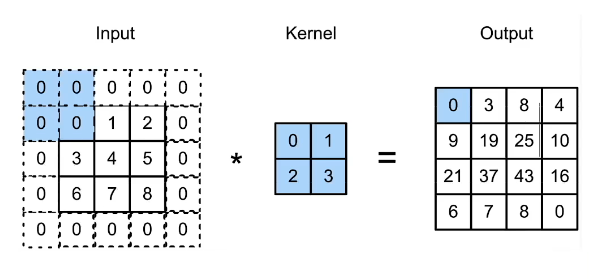
卷积层将输入和核矩阵进行交叉相关,加上偏移之后得到输出。

核矩阵和偏移是可学习的参数

核矩阵的大小是超参数(在训练前就已经定义好)

比较好的思想:高、宽减半,通道数翻一倍

二维交叉与二维卷积

没有本质的区别,

\(y_{i,j}=\sum_{a=1}^{h}\sum_{b=1}^{w}w_{a,b}x_{i+a,j+b}\)

索引前多了负号,因为w是学习的值,所以没有本质区别

\(y_{i,j}=\sum_{a=1}^{h}\sum_{b=1}^{w}w_{-a,-b}x_{i+a,j+b}\)

不同的维度

  • 一维

    \(y_i=\sum_{a=1}^hw_ax_{i+a}\)

    处理文本、语言、时间序列

  • 三维

    \(y_{i,j,k}=\sum_{a=1}^h\sum_{b=1}^w\sum_{c=1}^d\)

实现二维卷积层

互相关运算

1
2
3
4
5
6
7
def corr2d(X,K):
h,w = K.shape
Y = torch.zeros((X.shape[0]-h+1,X.shape[1]-w+1))
for i in range(Y.shape[0]):
for j in range (Y.shape[1]):
Y[i,j]=(X[i:i+h,j:j+w]*K).sum()
return Y
1
2
3
4
5
6
7
class Conv2D(nn.Module):
def __init__(self,kernel_size):
super().__init__()
self.weight = nn.Parameter(torch.rand(kernel_size))
self.bias == nn.Parameter(torch.zeros(1))
def forward(self,X):
return corr2d(x,self.weight) + self.bias

例子

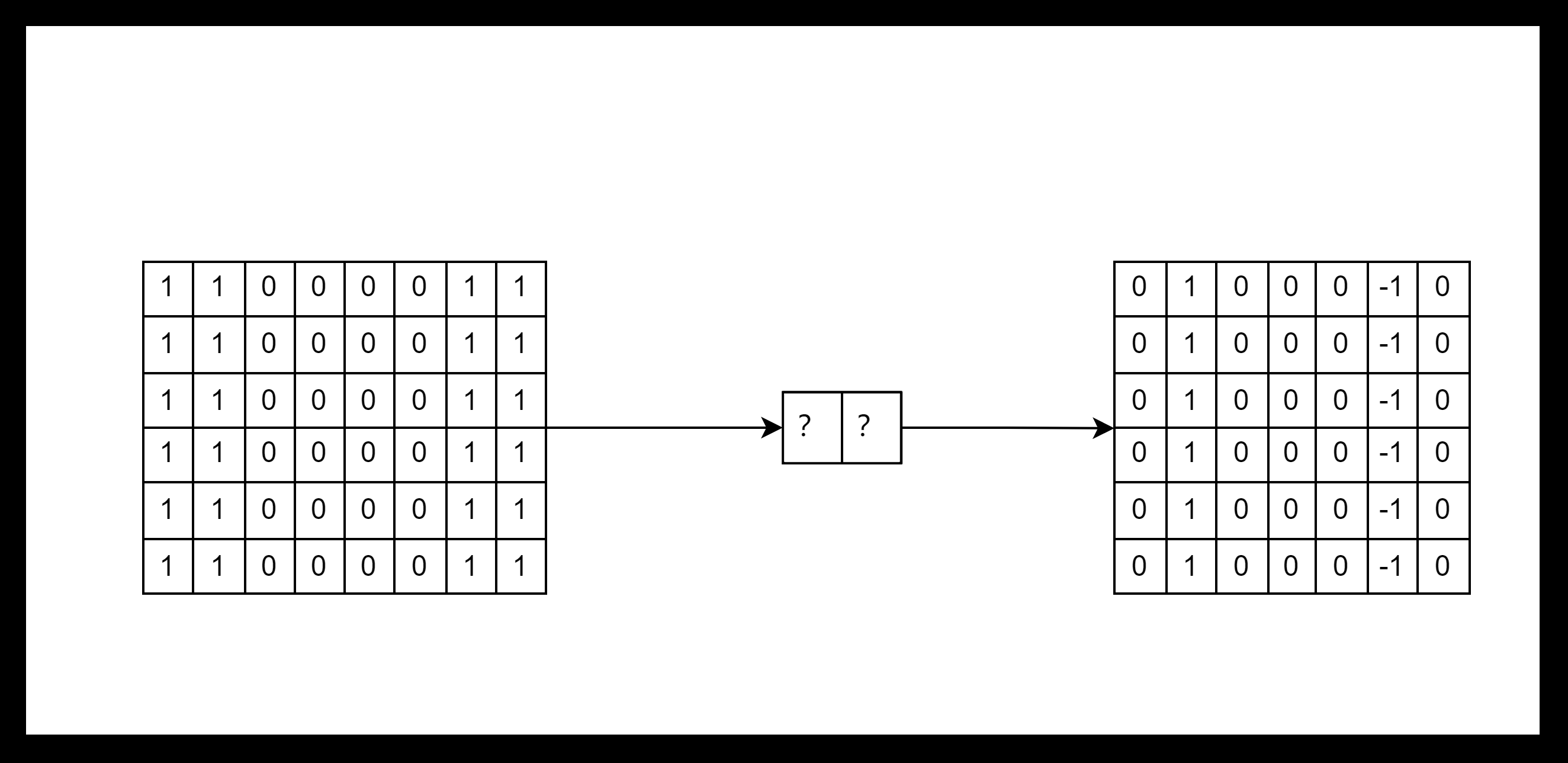
求卷积核说明图
1
2
3
4
5
6
7
8
9
10
11
12
13
14
15
16
17
18
19
20
21
22
23
24
25
26
27
28
import torch
from torch import nn

conv2d = nn.Conv2d(1,1,kernel_size=(1,2),bias=False)

# 第一个张量矩阵
X = torch.ones((6, 8))
X[:, 2:6] = 0
X = X.reshape((1,1,6,8))
# 第二个张量矩阵
Y = torch.zeros((6,7))
Y[:,1] = 1
Y[:,-2]= -1
Y = Y.reshape((1,1,6,7))

for i in range(100):
Y_hat = conv2d(X)
l = (Y_hat - Y) ** 2
conv2d.zero_grad()
l.sum().backward()
# 迭代卷积核
conv2d.weight.data[:] -= 3e-2 * conv2d.weight.grad
if (i + 1) % 2 == 0:
print(f'epoch {i+1}, loss {l.sum():.3f}')

print(conv2d.weight.data.reshape((1,2)))
#tensor([[ 1.0000, -1.0000]])
#表示 中间问号里的卷积核为[1,-1] 能够使得X卷积计算为Y

填充和步幅

原因

每次使用卷积核都能减小输出的大小

  • input :32x32 kernel_size:5x5
    • 根据kernel_size 每卷积一次,减少4x4
    • 第一次卷积 32x32 :arrow_right:28x28
    • ...
    • 第七次卷积结果 4x4
  • 总结:每卷积一次,形状从\(n_h \times n_w\)减小到\((n_w-k_h+1)\times(n_w-k_w+1)\)
    • 其中k_h为卷积核的高,k_w为卷积核的宽

填充

卷积填充

在输入数据的四周进行数据填充

  • 在上下左右分别添加0
    • 输出形状为\((n_h-k_h+p_h+1) \times(n_w-k_w+p_w+1)\)
    • 通常取 \(p_h=k_h-1\),\(p_w=k_w-1\)
      • k为奇数,在上下两侧填充\(p_h/2\)
      • k为偶数,在上侧填充\([p_h/2]\),在下侧填充\([p_h/2]\)

步幅

控制卷积核移动的幅度,可以每次不止移动一格。

可以使得在输入较大、卷积核较小的情况下,快速达到较小的输出,减少中间的卷积层数。

  • 给定高度\(s_h\)和宽度\(s_w\)的步幅,输出形状为:\([(n_h-k_h+p_h+s_h)/s_h]\times[(n_w-k_w+p_w+s_w)/s_w]\)
    • 如果 \(p_h=k_h-1\),\(p_w=k_w-1\),输出形状为:\([(n_h+s_h-1)/s_h]\times[(n_w+s_w-1)/s_w]\)
    • 如果输入高度和宽度可以被步幅整除,输出形状为:\((n_h/s_h)\times(n_w/s_w)\)

总结

  • 填充和步幅都是卷积层的超参数,声明网络的时候加上就行
  • 填充在输入周围添加额外的行/列,来控制输出形状的减少量,常设为p = k-1核-1
  • 步幅是每次滑动核窗口时的行/列的步长,可以成倍地减少输出形状

例子

1
2
3
4
5
6
7
8
9
10
11
12
13
14
15
16
17
18
19
20
21
22
23
24
25
26
27
28
29
30
31
32
33
34
35
36
import torch
from torch import nn
import torch.nn.functional as F

# 在所有侧边填充一个像素
def comp_conv2d(conv2d,X):
# (批量大小、通道、高度、宽度)
X = X.reshape((1,1)+X.shape)

Y = conv2d(X)
return Y.reshape(Y.shape[2:])

# 定义一个输入输出通道数为1,kernel大小为3,填充为1的卷积神经网络
conv2d = nn.Conv2d(1,1,kernel_size=3,padding=1)
X = torch.rand(size=(8,8))
print(comp_conv2d(conv2d,X).shape)
# 8 x 8

# kernal 宽高不一样的时候,注意padding填充的设置
# 8-5+ 2x2(上下填充的)+1 = 8
# 8-3+ 1x2(左右填充的)+1 = 8
# (kernel_size - 1 )/ 2
conv2d = nn.Conv2d(1,1,kernel_size=(5,3),padding=(2,1))
print(comp_conv2d(conv2d,X).shape)
# 8 x 8

# 步幅为2的情况
conv2d = nn.Conv2d(1,1,kernel_size=3,padding=1,stride=2)
print(comp_conv2d(conv2d,X).shape)
# 4 x 4

conv2d = nn.Conv2d(1,1,kernel_size=(5,3),padding=(0,1),stride=(3,4))
print(comp_conv2d(conv2d,X).shape)
# 2 x 2
# [(8-3+0x2+3)/3] = 2
# [(8-5+1x2+4)/4] = 2

输入和输出通道

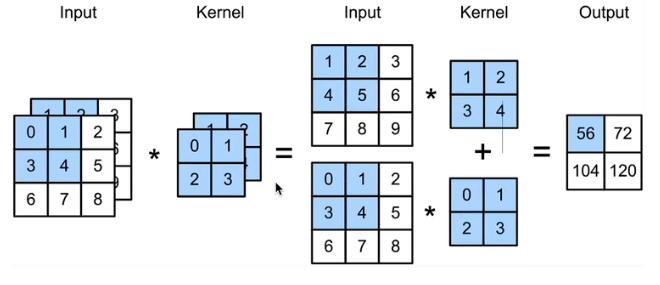
多输入通道的计算方式

每个通道有自己的卷积核

\(c_i\):输入通道 channel_input

\(c_o\):输出通道channel_output

单输入通道

每个通道和自己的卷积核进行计算

  • 输入 X:\(c_i\times n_h\times n_w\)
  • W:\(c_i\times k_h\times k_w\)
  • 输出Y:\(m_h\times m_w\)

多输入通道

多个卷积核、每个核生成一个通道

每个通道可有用于识别不同的特定模式

  • 输入 X:\(c_i\times n_h\times n_w\)
  • W:\(c_o\times c_i\times k_h\times k_w\)
  • 输出Y:\(c_o\times m_h\times m_w\)
1
2
3
4
5
6
7
8
9
10
11
12
13
14
#多输入通道
import torch
from d2l import torch as d2l

def corr2d_multi_in(X,K):
# zip 将每一个输入和对应的卷积核绑定
return sum(d2l.corr2d(x,k) for x,k in zip(X,K))


X = torch.tensor([[[0.0, 1.0, 2.0], [3.0, 4.0, 5.0], [6.0, 7.0, 8.0]],
[[1.0, 2.0, 3.0], [4.0, 5.0, 6.0], [7.0, 8.0, 9.0]]])
K = torch.tensor([[[0.0, 1.0], [2.0, 3.0]], [[1.0, 2.0], [3.0, 4.0]]])

print(corr2d_multi_in(X, K))
1
2
3
4
5
6
7
8
9
#多输出通道
import torch
from d2l import torch as d2l

def corr2d_multi_in_out(X,K):
return torch.stack([corr2d_multi_in(X,k) for k in K],0)

K = torch.reshape((K,K+1,K+2),0)
print(K.shape)

1x1卷积层

参考:一文读懂卷积神经网络中的1x1卷积核 (qq.com)

不识别空间模式(没有周边像元参与),只是对多个通道同一位置的像元进行融合

\(k_h=k_w=1\)
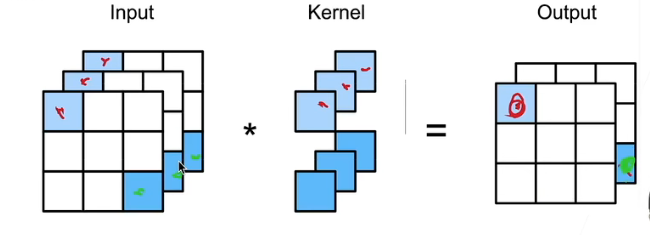
1x1卷积核计算过程

相当于输入形状为\(n_hn_w\times c_i\),权重为\(c_o\times c_i\)的全连接层

  • \(z=W\cdot x^T+b\)
    • \(W: \space c_o \times c_i\)
    • \(x:\space n_hn_w \times c_i\)
  • 对应位置按权重(Kernel)相加
1
2
3
4
5
6
7
8
9
10
11
12
13
14
15
16
17
18
19
20
21
22
def corr2d_multi_in_out_1x1(X,K):
# 数据的维度、长宽
c_i,h,w = X.shape
# 核的个数,数据的输出维度
c_o = K.shape[0]
# X 拉成 h*w x c_i的张量
X = X.reshape((c_i,h*w))
# 卷积核,变成权重W
K= K.reshape((c_o,c_i))
# 实现全连接层的操作
Y = torch.matmul(K,X)
# 还原成矩阵
return Y.reshape((c_o,h,w))

# 输入
X = torch.normal(0, 1, (3, 3, 3))
# 卷积层 输出2 输入3 大小 1x1
K = torch.normal(0, 1, (2, 3, 1, 1))

Y1 = corr2d_multi_in_out_1x1(X, K)
Y2 = corr2d_multi_in_out(X, K)
assert float(torch.abs(Y1 - Y2).sum()) < 1e-6

总结

  • 输出通道数是卷积层的超参数
  • 每个输入通道有独立的二维卷积核,所有通道结果相加得到一个输出通道结果
  • 每个输出通道有独立的三维卷积核
  • [3,2,2,2] 输出通道为3,输入通道为2,卷积核高2,卷积核宽2
    • 有三个卷积核,每个卷积核有两层(是二维),卷积核大小为2x2

池化

二维最大池化
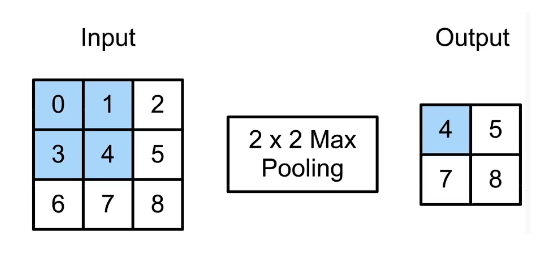
Pooling池化

返回滑动窗口中的最大值

  • 有填充和步幅
  • 没有可学习的参数,只有取最大的操作子
  • 每个输入通道应用池化层获得相应的输出通道
  • 输入通道数=输出通道数

二维平均池化

  • 和最大池化一样,操作子变为取平均
1
2
3
4
5
6
7
8
9
10
11
12
13
14
15
16
17
18
19
20
# 手写版本
def pool2d(X,pool_size,mode='max'):
p_h,p_w = pool_size
Y = torch.zeros((X.shape[0]-p_h+1,X.shape[1]-p_w+1))
for i in range(Y.shape[0]):
for j in range(Y.shape[1]):
if mode == 'max':
Y[i,j] = X[i:i+p_h,j:j+p_w].max()
elif mode =='avg':
Y[i,j] = X[i:i+p_h,j:j+p_w].mean()

return Y

# 创建最大池化层,窗口大小为3x3
# 框架默认步幅与池化窗口大小相同,所以步幅也为3
pool2d = nn.MaxPool2d(3)
# 也可以手动指定padding和stride
pool2d = nn.MaxPool2d(3,padding=1,stride=2)
# 窗口大小也可以自己指定
pool2d = nn.MaxPool2d((2,3),padding=(1,2),stride=(2,3))
1
2
3
4
5
6
7
8
#池化层多个通道中,每个通道单独计算
# 2 x 4 x 4
X = torch.cat((X,X+1),1)

pool2d = nn.MaxPool2d(3,padding=1,stride=2)
# 2 x 2 x 2
pool2d(X)

总结

  • 池化层返回窗口中的最大或者平均值,取决于操作子
  • 池化层能缓解卷积层对位置的敏感性
  • 同样有窗口大小、填充和步幅作为超参数

卷积层、全连接层参数个数计算

参考:CNN卷积层、全连接层的参数量、计算量

  • 卷积层参数量:卷积核元素的大小
    • 计算公式:参数量=(filter size * 前一层特征图的通道数 )* 当前层filter数量
  • 全连接层参数量:
    • 计算公式:见参考

批量归一化

问题

底部:靠近数据

顶部:靠近损失

训练过程中,方差和均值的分布在不同层之间发生变化

在持续的训练过程中,上面的收敛比较快,下面变化比较慢。

但是每次底部变化,底层的信息变了,顶部需要进行重新训练。

这个问题会导致收敛比较慢。

原因

  • 损失在网络计算的最后(上部),网络后面的层的训练比较快
  • 数据在网络的最底部
    • 底层训练很慢
    • 底层变化,整个网络的数据都发生变化
    • 最后的那些层需要学习很多次
    • 导致收敛变慢

解决方法

把不同层之间的均值和方差的分布固定住。

固定小批量里的均值和方差

\(\begin{split}\begin{aligned} \hat{\boldsymbol{\mu}}_\mathcal{B} &= \frac{1}{|\mathcal{B}|} \sum_{\mathbf{x} \in \mathcal{B}} \mathbf{x},\\ \hat{\boldsymbol{\sigma}}_\mathcal{B}^2 &= \frac{1}{|\mathcal{B}|} \sum_{\mathbf{x} \in \mathcal{B}} (\mathbf{x} - \hat{\boldsymbol{\mu}}_{\mathcal{B}})^2 + \epsilon.\end{aligned}\end{split}\)

\(\mathrm{BN}(\mathbf{x}) = \boldsymbol{\gamma} \odot \frac{\mathbf{x} - \hat{\boldsymbol{\mu}}_\mathcal{B}}{\hat{\boldsymbol{\sigma}}_\mathcal{B}} + \boldsymbol{\beta}.\)

\(\gamma \quad \beta\) 可学习的参数,当变为标准正态分布可能不太合适的话,可以用数据重新学习一个合适的方差和均值对数据进行优化。

批量归一化层

  • 可学习的参数为\(\gamma\quad\beta\)
  • 作用在
    • 全连接层和卷积层输入上
    • 全连接层和卷积层输出上,激活函数之前
      • 对输出数据减去均值除以方差,加上可以学习的\(\gamma\quad\beta\),在加上激活函数
  • 对于全连接层,作用在特征维
    • 全连接层输入是二维的
    • 行是样本,列是特征。
    • 作用在特征维度是对特征求均值和方差(列)
  • 对于卷积层,作用在通道维
    • 二维拓展到三维
    • Batch size x Channels x Height x Width
      • 样本数量: Batch size x Height x Width个像素
      • 每个像素:Channels 个通道(特征)
    • 对每个像素的通道计算均值和方差

代码

1
2
3
4
5
6
7
8
9
10
11
12
13
14
15
16
17
18
19
20
21
22
23
24
25
26
27
28
29
30
31
32
33
34
35
import torch
from torch import nn
from d2l import torch as d2l

# moving_mean,moving_var 整个数据集的均值和方差
# eps 极小值 避免数据集中含有0
# momentum 更新moving_mean,moving_var
def batch_norm(X,gamma,beta,moving_mean,moving_var,eps,momentum):
# 不算梯度,在做Inferance 推理
if not torch.is_grad_enabled():
# 为什么用全局的均值和方差
# 做推理的时候很多时候输入只是一个样本,一般算不出自己的均值和方差
X_hat = (X-moving_mean)/torch.sqrt(moving_var+eps)
else:
# 限定输入类型为全连接层和卷积层
assert len(X.shape) in (2,4)
if len(X.shape)==2:
# 批量大小、特征维度
# 对每一列的所有(行数个)样本求平均
# dim=0 压缩行维度
# 最后得到一个行向量
mean = X.mean(dim=0)
var = ((X-mean)**2).mean(dim=0)
else:
# 批量大小 通道数 高 宽 0 1 2 3
# dim=(0,2,3) 把批量大小、高、宽的全部通道数求均值
# keepdim = True 最终结果 1 x n x 1 x 1
mean = X.mean(dim=(0,2,3),keepdim=True)
var = ((X-mean)**2).mean(dim=(0,2,3),keepdim=True)
X_hat = (X-mean) / torch.sqrt(var+eps)
moving_mean = momentum * moving_mean +(1.0-momentum)*mean
moving_var = momentum * moving_var + (1.0-momentum)*var
Y = gamma * X_hat +beta

return Y,moving_mean.data,moving_var.data
1
2
3
4
5
6
7
8
9
10
11
12
13
14
15
16
17
18
19
20
21
class BatchNorm(nn.Module):
def __init__(self,num_features,num_dims):
super().__init__()
if num_dims==2:
shape = (1,num_features)
else:
shape=(1,num_features,1,1)
# nn.Parameter() 将张量注册为模块的参数
self.gamma = nn.Parameter(torch.ones(shape))
self.beta = nn.Parameter(torch.zeros(shape))
self.moving_mean = torch.zeros(shape)
self.moving_var = torch.ones(shape)

def forward(self,X):
if self.moving_mean.device != X.device:
self.moving_mean = self.moving_mean.to(X.device)
self.moving_var = self.moving_var.to(X.device)

Y,self.moving_mean,self.moving_var = batch_norm(X,self.gamma,self.beta,self.moving_mean,self.moving_var,eps=1e-5,momentum=0.9)

return Y
1
2
3
4
5
6
7
8
9
10
11
12
13
14
15
16
17
18
19
net = nn.Sequential(
# 输入通道1 输出通道6 卷积核大小 5
nn.Conv2d(1,6,kernel_size=5),BatchNorm(6,num_dims=4),nn.Sigmoid(),nn.MaxPool2d(kernel_size=2,stride=2),
nn.Conv2d(6,16,kernel_size=5),BatchNorm(16,num_dims=4),nn.Sigmoid(),nn.MaxPool2d(kernel_size=2,stride=2),
nn.Flatten(),nn.Linear(16*4*4,120),
BatchNorm(120,num_dims=2),nn.Sigmoid(),
nn.Linear(120,84),BatchNorm(84,num_dims=2),
nn.Sigmoid(),nn.Linear(84,10)
)

#简明版本 调用nn.BatchNorm2d()
net = nn.Sequential(
nn.Conv2d(1, 6, kernel_size=5), nn.BatchNorm2d(6), nn.Sigmoid(),
nn.AvgPool2d(kernel_size=2, stride=2),
nn.Conv2d(6, 16, kernel_size=5), nn.BatchNorm2d(16), nn.Sigmoid(),
nn.AvgPool2d(kernel_size=2, stride=2), nn.Flatten(),
nn.Linear(256, 120), nn.BatchNorm1d(120), nn.Sigmoid(),
nn.Linear(120, 84), nn.BatchNorm1d(84), nn.Sigmoid(),
nn.Linear(84, 10))
1
2
3
lr, num_epochs, batch_size = 1.0, 10, 256
train_iter, test_iter = d2l.load_data_fashion_mnist(batch_size)
d2l.train_ch6(net, train_iter, test_iter, num_epochs, lr, d2l.try_gpu())

总结

  • 批量归一化固定小批量中的均值和方差,然后学习出合适的偏移和缩放
  • 可以加速收敛速度,但是一般不改变模型精度
  • 可以允许用更大的学习率进行训练

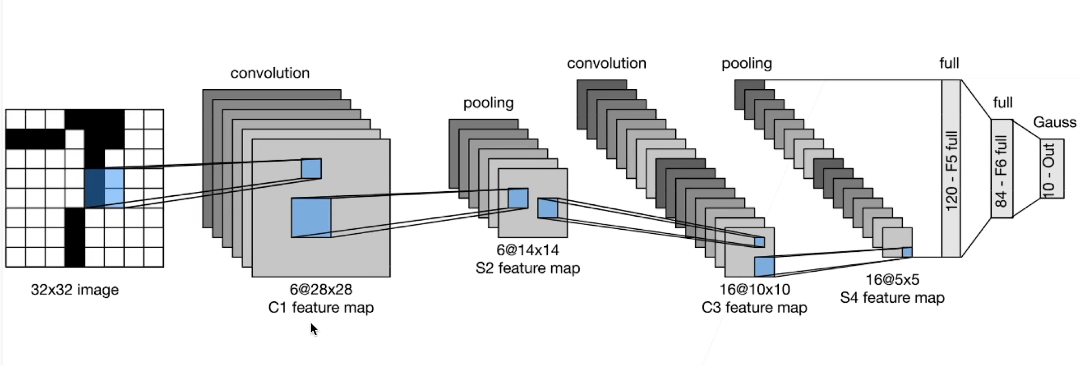
LeNet 经典卷积神经网络

LeNet卷积网络
1
2
3
4
5
6
7
8
9
10
11
12
13
14
15
16
17
18
19
20
21
22
23
24
25
26
27
28
29
30
31
32
33
34
35
36
37
38
39
40
41
42
43
44
45
46
47
48
49
50
51
52
53
54
55
56
57
58
59
60
61
62
63
64
65
66
67
68
69
70
71
72
73
74
75
76
77
78
79
80
81
82
83
84
85
86
87
88
89
90
91
92
93
94
95
96
97
98
99
100
101
102
103
104
105
106
107
108
109
110
111
112
113
114
115
116
117
118
119
120
121
122
123
import torch
from torch import nn
from d2l import torch as d2l

class Reshape(torch.nn.Moudle):
def forward(self,x):
# view()相当于reshape、resize,对Tensor的形状进行调整。
return x.view(-1,1,28,28)

net = nn.Sequential(
Reshape(),
# 输入为1 输出为6 卷积核 5x5 padding=2 28x28 --> 32x32
# nn.Sigmoid()函数的作用?还不是很清楚
nn.Conv2d(1,6,kernel_size=5,padding=2),nn.Sigmoid(),
nn.AvgPool2d(kernel_size=2,stride=2),
nn.Conv2d(6,16,kernel_size=5),nn.Sigmoid(),
nn.AvgPool2d(kernel_size=2,stride=2),
# 卷积层输出的是4D数据 1 x 16 x 5 x 5 1:批量
# 拉平为一维数据输入多层感知机
nn.Flatten(),
nn.Linear(16*5*5,120),nn.Sigmoid(),
nn.Linear(120,84),nn.Sigmoid(),
nn.Linear(84,10)
)

# Reshape 批量:1 输出通道:1 高、宽 28
Reshape output shape: torch.Size([1, 1, 28, 28])
# Padding之后:高、宽 32 批量:1 输出通道:6 核大小5 32-5+1 = 28 输出的高、宽还是28
Conv2d output shape: torch.Size([1, 6, 28, 28])
# 激活函数 对shape不做操作
Sigmoid output shape: torch.Size([1, 6, 28, 28])
# 平均池化层 核大小2 步长2
AvgPool2d output shape: torch.Size([1, 6, 14, 14])
# 批量:1 输出通道:16 输出高、宽:10 (16个核 每个核对6个通道加权求和再输出)
Conv2d output shape: torch.Size([1, 16, 10, 10])
# 激活函数 对shape不做操作
Sigmoid output shape: torch.Size([1, 16, 10, 10])
# 批量:1 输出通道:16 输出高、宽:5
AvgPool2d output shape: torch.Size([1, 16, 5, 5])
# 批量:1 拉平操作 将 1 x 16 x 5 x 5 的 4D 数据降低为一个维度
Flatten output shape: torch.Size([1, 400])
# MLP 隐藏层 400->120
Linear output shape: torch.Size([1, 120])
# 激活函数 对shape不做操作
Sigmoid output shape: torch.Size([1, 120])
# MLP 隐藏层 120->84
Linear output shape: torch.Size([1, 84])
# 激活函数 对shape不做操作
Sigmoid output shape: torch.Size([1, 84])
# MLP 84->10
Linear output shape: torch.Size([1, 10])


batch_size = 256
train_iter, test_iter = d2l.load_data_fashion_mnist(batch_size=batch_size)

def evaluate_accuracy_gpu(net, data_iter, device=None): #@save
"""使用GPU计算模型在数据集上的精度"""
if isinstance(net, nn.Module):
net.eval() # 设置为评估模式
if not device:
# 设置训练的device
device = next(iter(net.parameters())).device
# 正确预测的数量,总预测的数量
metric = d2l.Accumulator(2)
with torch.no_grad():
for X, y in data_iter:
if isinstance(X, list):
# BERT微调所需的(之后将介绍)
X = [x.to(device) for x in X]
else:
X = X.to(device)
y = y.to(device)
metric.add(d2l.accuracy(net(X), y), y.numel())
return metric[0] / metric[1]

#@save
def train_ch6(net, train_iter, test_iter, num_epochs, lr, device):
"""用GPU训练模型(在第六章定义)"""
def init_weights(m):
if type(m) == nn.Linear or type(m) == nn.Conv2d:
# 全连接层和卷积层用xavier_uniform初始化
# 根据输入输出大小,使得用随机数的时候,输入和输出的方差是差不多的
nn.init.xavier_uniform_(m.weight)
net.apply(init_weights)
print('training on', device)
net.to(device)
# SGD优化
optimizer = torch.optim.SGD(net.parameters(), lr=lr)
# 分类用
loss = nn.CrossEntropyLoss()
animator = d2l.Animator(xlabel='epoch', xlim=[1, num_epochs],
legend=['train loss', 'train acc', 'test acc'])
timer, num_batches = d2l.Timer(), len(train_iter)
for epoch in range(num_epochs):
# 训练损失之和,训练准确率之和,样本数
metric = d2l.Accumulator(3)
net.train()
for i, (X, y) in enumerate(train_iter):
timer.start()
optimizer.zero_grad()
X, y = X.to(device), y.to(device)
y_hat = net(X)
l = loss(y_hat, y)
l.backward()
optimizer.step()
with torch.no_grad():
metric.add(l * X.shape[0], d2l.accuracy(y_hat, y), X.shape[0])
timer.stop()
train_l = metric[0] / metric[2]
train_acc = metric[1] / metric[2]
if (i + 1) % (num_batches // 5) == 0 or i == num_batches - 1:
animator.add(epoch + (i + 1) / num_batches,
(train_l, train_acc, None))
test_acc = evaluate_accuracy_gpu(net, test_iter)
animator.add(epoch + 1, (None, None, test_acc))
print(f'loss {train_l:.3f}, train acc {train_acc:.3f}, '
f'test acc {test_acc:.3f}')
print(f'{metric[2] * num_epochs / timer.sum():.1f} examples/sec '
f'on {str(device)}')

lr, num_epochs = 0.9, 10
train_ch6(net, train_iter, test_iter, num_epochs, lr, d2l.try_gpu())

AlexNet 卷积神经网络

特点

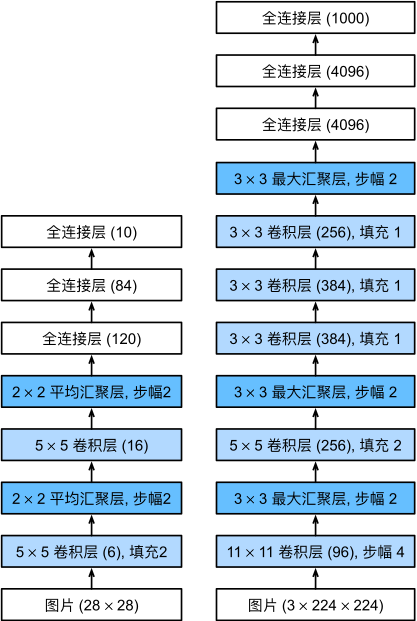
更大更深的LeNet

AlexNet与LeNet对比

主要改进

  • 丢弃法
  • ReLU
  • MaxPooling

代码

1
2
3
4
5
6
7
8
9
10
11
12
13
14
15
16
17
18
19
20
21
22
23
24
25
26
27
28
import torch
from torch import nn
from d2l import torch as d2l

net = nn.Sequential(
# 这里使用一个11*11的更大窗口来捕捉对象。
# 同时,步幅为4,以减少输出的高度和宽度。
# 另外,输出通道的数目远大于LeNet
nn.Conv2d(1, 96, kernel_size=11, stride=4, padding=1), nn.ReLU(),
nn.MaxPool2d(kernel_size=3, stride=2),
# 减小卷积窗口,使用填充为2来使得输入与输出的高和宽一致,且增大输出通道数
nn.Conv2d(96, 256, kernel_size=5, padding=2), nn.ReLU(),
nn.MaxPool2d(kernel_size=3, stride=2),
# 使用三个连续的卷积层和较小的卷积窗口。
# 除了最后的卷积层,输出通道的数量进一步增加。
# 在前两个卷积层之后,汇聚层不用于减少输入的高度和宽度
nn.Conv2d(256, 384, kernel_size=3, padding=1), nn.ReLU(),
nn.Conv2d(384, 384, kernel_size=3, padding=1), nn.ReLU(),
nn.Conv2d(384, 256, kernel_size=3, padding=1), nn.ReLU(),
nn.MaxPool2d(kernel_size=3, stride=2),
nn.Flatten(),
# 这里,全连接层的输出数量是LeNet中的好几倍。使用dropout层来减轻过拟合
nn.Linear(6400, 4096), nn.ReLU(),
nn.Dropout(p=0.5),
nn.Linear(4096, 4096), nn.ReLU(),
nn.Dropout(p=0.5),
# 最后是输出层。由于这里使用Fashion-MNIST,所以用类别数为10,而非论文中的1000
nn.Linear(4096, 10))
1
2
3
4
5
6
7
8
9
10
11
12
13
14
15
16
17
18
19
20
21
22
23
24
25
26
27
28
29
30
31
32
33
34
35
36
37
38
# 查看数据再Net中如何变换
X = torch.randn(1, 1, 224, 224)
for layer in net:
X=layer(X)
print(layer.__class__.__name__,'output shape:\t',X.shape)

#nn.Conv2d(1, 96, kernel_size=11, stride=4, padding=1)
Conv2d output shape: torch.Size([1, 96, 54, 54])
ReLU output shape: torch.Size([1, 96, 54, 54])
# nn.MaxPool2d(kernel_size=3, stride=2)
MaxPool2d output shape: torch.Size([1, 96, 26, 26])
# nn.Conv2d(96, 256, kernel_size=5, padding=2)
Conv2d output shape: torch.Size([1, 256, 26, 26])
ReLU output shape: torch.Size([1, 256, 26, 26])
# nn.MaxPool2d(kernel_size=3, stride=2)
MaxPool2d output shape: torch.Size([1, 256, 12, 12])\
# nn.Conv2d(256, 384, kernel_size=3, padding=1)
Conv2d output shape: torch.Size([1, 384, 12, 12])
ReLU output shape: torch.Size([1, 384, 12, 12])
# nn.Conv2d(384, 384, kernel_size=3, padding=1)
Conv2d output shape: torch.Size([1, 384, 12, 12])
ReLU output shape: torch.Size([1, 384, 12, 12])
# nn.Conv2d(384, 256, kernel_size=3, padding=1)
Conv2d output shape: torch.Size([1, 256, 12, 12])
ReLU output shape: torch.Size([1, 256, 12, 12])
# nn.MaxPool2d(kernel_size=3, stride=2)
MaxPool2d output shape: torch.Size([1, 256, 5, 5])
Flatten output shape: torch.Size([1, 6400])
# nn.Linear(6400, 4096)
Linear output shape: torch.Size([1, 4096])
ReLU output shape: torch.Size([1, 4096])
Dropout output shape: torch.Size([1, 4096])
# nn.Linear(4096, 4096)
Linear output shape: torch.Size([1, 4096])
ReLU output shape: torch.Size([1, 4096])
# nn.Linear(4096, 10)
Dropout output shape: torch.Size([1, 4096])
Linear output shape: torch.Size([1, 10])

VGG 使用块的网络

特点

更深更窄

  • 堆更多的3 x 3的卷积核

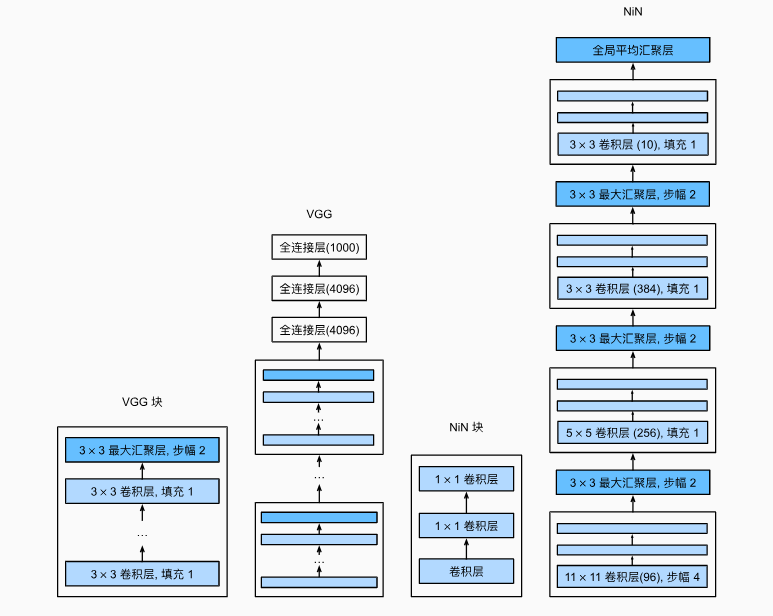
VGG块

  • n层,m通道的卷积层
  • 最后加个2 x 2的最大池化层

VGG架构

  • AlexNet整个卷积层的架构替换为nVGG块,VGG-16VGG-19
  • 块可重复使用,不同的卷积块个数和超参数可以得到不同复杂程度的变种
nn.Sequential()

代码

1
2
3
4
5
6
7
8
9
10
11
12
13
14
15
16
17
18
19
import torch
from torch import nn
from d2l import torch as d2l


def vgg_block(num_convs,in_channels,out_channels):
layers = []
# 单纯用个for循环,不需要循环变量
for _ in range(num_convs):
layers.append(nn.Conv2d(
in_channels,out_channels,kernel_size=3,padding=1))
layers.append(nn.ReLU())
in_channels = out_channels
layers.append(nn.MaxPool2d(kernel_size=2,stride=2))
# nn.Sequential() 接受orderDict或者Module数据
# layers为 List类型数据 前面加上*表示将List中内容解包
# 相当于把一个一个模型拿出来,放到Sequential中
return nn.Sequential(*layers)

1
2
3
4
5
6
7
8
9
10
11
12
13
14
15
16
17
18
19
conv_arch = ((1,64),(1,128),(2,256),(2,512),(2,512))

def vgg(conv_arch):
conv_blks = []
in_channels = 1
# 卷积层部分
for (num_convs, out_channels) in conv_arch:
conv_blks.append(vgg_block(num_convs, in_channels, out_channels))
in_channels = out_channels

return nn.Sequential(
*conv_blks, nn.Flatten(),
# 全连接层部分
nn.Linear(out_channels * 7 * 7, 4096), nn.ReLU(), nn.Dropout(0.5),
nn.Linear(4096, 4096), nn.ReLU(), nn.Dropout(0.5),
nn.Linear(4096, 10))

net = vgg(conv_arch)

1
2
3
4
5
6
7
8
9
10
11
12
13
14
15
16
17
18
19
X = torch.randn(size=(1,1,224,224))
for blk in net:
X = blk(X)
print(blk.__class__.__name__,'output shape:\t',X.shape)

# 每个Sequential VGG块的作用,通道数加倍,高宽减半
Sequential output shape: torch.Size([1, 64, 112, 112])
Sequential output shape: torch.Size([1, 128, 56, 56])
Sequential output shape: torch.Size([1, 256, 28, 28])
Sequential output shape: torch.Size([1, 512, 14, 14])
Sequential output shape: torch.Size([1, 512, 7, 7])
Flatten output shape: torch.Size([1, 25088])
Linear output shape: torch.Size([1, 4096])
ReLU output shape: torch.Size([1, 4096])
Dropout output shape: torch.Size([1, 4096])
Linear output shape: torch.Size([1, 4096])
ReLU output shape: torch.Size([1, 4096])
Dropout output shape: torch.Size([1, 4096])
Linear output shape: torch.Size([1, 10])
1
2
3
4
# 减小批次
ratio = 4
small_conv_arch = [(pair[0], pair[1] // ratio) for pair in conv_arch]
net = vgg(small_conv_arch)
1
2
3
lr, num_epochs, batch_size = 0.05, 10, 128
train_iter, test_iter = d2l.load_data_fashion_mnist(batch_size, resize=224)
d2l.train_ch6(net, train_iter, test_iter, num_epochs, lr, d2l.try_gpu())

NiN 神经网络

原因

  • 卷积层参数个数: \(c_i \times c_o \times k^2\)
  • 卷积层后第一个全连接层参数个数:
    • 相当于用output_channels\(1\times1\)的卷积核进行卷积计算
    • \(c_i \times c_o \times k^2\)

块架构

VGG vs NiN
  • 一个卷积层后跟两个全连接层
    • 步幅为1,无填充,输出形状跟卷积层输出一样
    • 起到全连接层的作用

特点

  • 无全连接层
  • 交替使用NiN块和步幅为2的最大池化层
    • 逐步减少高宽(减半)和增大通道数(加倍)
  • 最后使用全局平均池化层得到输出
    • 输入通道数是类别数
    • 池化层的高宽=原始输入的高宽

代码

1
2
3
4
5
6
7
8
9
10
11
import torch
import torch.nn as nn
from d2l import torch as d2l

# 定义NiN块结构
def nin_block(in_channels,out_channels,kernel_size,stride,padding):
return nn.Sequential(
nn.Conv2d(in_channels,out_channels,kernel_size,stride,padding),nn.ReLU(),
nn.Conv2d(out_channels,out_channels,kernel_size=1),nn.ReLU(),
)
1
2
3
4
5
6
7
8
9
10
11
12
13
14
# 构建网络序列
net = nn.Sequential(
nin_block(1,96,kernel_size=11,stride=4,padding=0),
nn.MaxPool2d(kernel_size=3, stride=2),
nin_block(96,256,kernel_size=5,stride=1,padding=2),
nn.MaxPool2d(kernel_size=3, stride=2),
nin_block(256,384,kernel_size=3,stride=1,padding=1),
nn.MaxPool2d(kernel_size=3, stride=2),
nn.Dropout(0.5),
nin_block(384,10,kernel_size=3,stride=1,padding=1),
nn.AdaptiveAvgPool2d((1,1)),
# 把数据拉成 batch_size x 10
nn.Flatten()
)
1
2
3
4
5
6
# 批次 1 大小 1 x 224 x 224
X = torch.rand(size=(1,1,224,224))
# 打印网络信息
for layer in net:
X = layer(X)
print(layer.__class__.__name__,'output:\t',X.shape)
1
2
3
4
# 训练
lr, num_epochs, batch_size = 0.1, 10, 128
train_iter, test_iter = d2l.load_data_fashion_mnist(batch_size, resize=224)
d2l.train_ch6(net, train_iter, test_iter, num_epochs, lr, d2l.try_gpu())

GoogLeNet 网络

特点

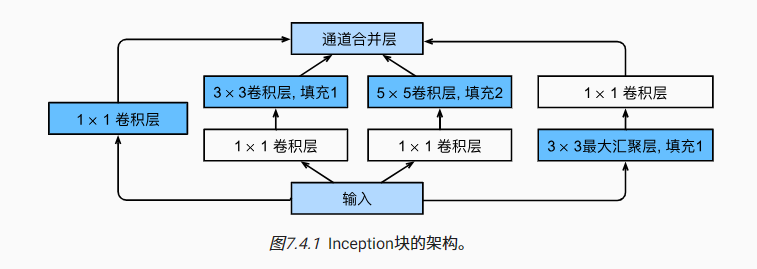
  • 引入了Inception

    Inception Block

    Inception块由四条并行路径组成。 前三条路径使用窗口大小为1×1、3×3和5×5的卷积层,从不同空间大小中提取信息。 中间的两条路径在输入上执行1×1卷积,以减少通道数,从而降低模型的复杂性。 第四条路径使用3×3最大汇聚层,然后使用1×1卷积层来改变通道数。 这四条路径都使用合适的填充来使输入与输出的高和宽一致,最后我们将每条线路的输出在通道维度上连结,并构成Inception块的输出。在Inception块中,通常调整的超参数是每层输出通道数。

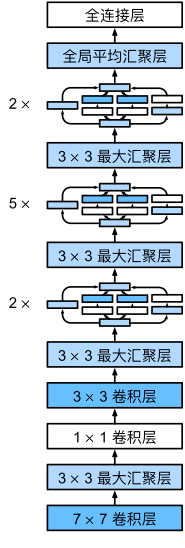
  • 基于Inception块,构建了网络

    GooLeNet架构

代码

1
2
3
4
5
6
7
8
9
10
11
12
13
14
15
16
17
18
19
20
21
22
23
24
25
26
27
28
29
import torch
from torch import nn
from torch.nn import functional as F
from d2l import torch as d2l

# 定义Inception块
class Inception(nn.Module):
# c1--c4是每条路径的输出通道数
def __init__(self, in_channels, c1, c2, c3, c4, **kwargs):
super(Inception, self).__init__(**kwargs)
# 线路1,单1x1卷积层
self.p1_1 = nn.Conv2d(in_channels, c1, kernel_size=1)
# 线路2,1x1卷积层后接3x3卷积层
self.p2_1 = nn.Conv2d(in_channels, c2[0], kernel_size=1)
self.p2_2 = nn.Conv2d(c2[0], c2[1], kernel_size=3, padding=1)
# 线路3,1x1卷积层后接5x5卷积层
self.p3_1 = nn.Conv2d(in_channels, c3[0], kernel_size=1)
self.p3_2 = nn.Conv2d(c3[0], c3[1], kernel_size=5, padding=2)
# 线路4,3x3最大汇聚层后接1x1卷积层
self.p4_1 = nn.MaxPool2d(kernel_size=3, stride=1, padding=1)
self.p4_2 = nn.Conv2d(in_channels, c4, kernel_size=1)

def forward(self, x):
p1 = F.relu(self.p1_1(x))
p2 = F.relu(self.p2_2(F.relu(self.p2_1(x))))
p3 = F.relu(self.p3_2(F.relu(self.p3_1(x))))
p4 = F.relu(self.p4_2(self.p4_1(x)))
# 在通道维度上连结输出
return torch.cat((p1, p2, p3, p4), dim=1)
1
2
3
4
5
6
7
8
9
10
11
12
13
14
15
16
17
18
19
20
21
22
23
24
25
26
27
28
29
30
# 定义网络的各个部分
b1 = nn.Sequential(
nn.Conv2d(1,64,kernel_size=7,stride=2,padding=3),
nn.ReLU(),
nn.MaxPool2d(kernel_size=3,stride=2,padding=1)
)

b2 = nn.Sequential(nn.Conv2d(64, 64, kernel_size=1),
nn.ReLU(),
nn.Conv2d(64, 192, kernel_size=3, padding=1),
nn.ReLU(),
nn.MaxPool2d(kernel_size=3, stride=2, padding=1))

b3 = nn.Sequential(Inception(192, 64, (96, 128), (16, 32), 32),
Inception(256, 128, (128, 192), (32, 96), 64),
nn.MaxPool2d(kernel_size=3, stride=2, padding=1))

b4 = nn.Sequential(Inception(480, 192, (96, 208), (16, 48), 64),
Inception(512, 160, (112, 224), (24, 64), 64),
Inception(512, 128, (128, 256), (24, 64), 64),
Inception(512, 112, (144, 288), (32, 64), 64),
Inception(528, 256, (160, 320), (32, 128), 128),
nn.MaxPool2d(kernel_size=3, stride=2, padding=1))

b5 = nn.Sequential(Inception(832, 256, (160, 320), (32, 128), 128),
Inception(832, 384, (192, 384), (48, 128), 128),
nn.AdaptiveAvgPool2d((1,1)),
nn.Flatten())

net = nn.Sequential(b1, b2, b3, b4, b5, nn.Linear(1024, 10))
1
2
3
4
5
6
7
8
9
10
11
12
# 用小批量数据打印网络信息
X = torch.rand(size=(1, 1, 96, 96))
for layer in net:
X = layer(X)
print(layer.__class__.__name__,'output shape:\t', X.shape)

Sequential output shape: torch.Size([1, 64, 24, 24])
Sequential output shape: torch.Size([1, 192, 12, 12])
Sequential output shape: torch.Size([1, 480, 6, 6])
Sequential output shape: torch.Size([1, 832, 3, 3])
Sequential output shape: torch.Size([1, 1024])
Linear output shape: torch.Size([1, 10])
1
2
3
4
#训练
lr, num_epochs, batch_size = 0.1, 10, 128
train_iter, test_iter = d2l.load_data_fashion_mnist(batch_size, resize=96)
d2l.train_ch6(net, train_iter, test_iter, num_epochs, lr, d2l.try_gpu())

ResNet 残差网络

特点

保证新加入的层的使得效果至少不会变差

残差块

  • 串联一个层改变函数类,扩大函数类
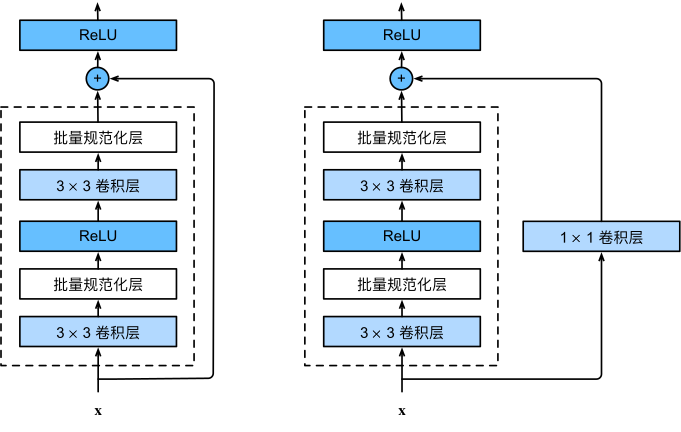
  • 残差块加入快速通道得到\(f(x) = x + g(x)\)的结构
resnet-block

原来的向后传播,或者加入一个1x1卷积层来变换通道数量使得能够继续向后

  • 即使中间的块什么都没有学到,之前的层的结果还是能够继续向后传播
  • 类似VGG和GoogLeNet的总体架构,但是替换成了ResNet块

种类

  • 高宽减半ResNet块(步幅为2)
  • 后接多个高宽不变ResNet

代码

1
2
3
4
5
6
7
8
9
10
11
12
13
14
15
16
17
18
19
20
21
22
23
24
25
26
27
28
29
30
31
from torch.nn import functional as F
from d2l import torch as d2l
import torch.nn as nn


# 定义Residual块
class Residual(nn.Module):
def __init__(self,input_channels,num_channels,use_1x1conv=False,strides=1):
super().__init__()
self.conv1 = nn.Conv2d(input_channels,num_channels,kernel_size=3,padding=1,stride=strides)
self.conv2 = nn.Conv2d(num_channels,num_channels,kernel_size=3,padding=1)

if use_1x1conv:
self.conv3 = nn.Conv2d(input_channels,num_channels,kernel_size=1,stride=strides)
else:
self.conv3 = None
self.bn1 = nn.BatchNorm2d(num_channels)
self.bn2 = nn.BatchNorm2d(num_channels)
# inplace直接操作input,不另外开辟内存进ReLU操作
# 原地更新
self.relu = nn.ReLU(inplace=True)

def forward(self,X):
Y = F.relu(self.bn1(self.conv1(X)))
Y = self.bn2(self.conv2(Y))
if self.conv3:
X = self.conv3(X)
Y += X

return F.relu(Y)

1
2
3
4
5
6
7
8
9
10
11
12
13
14
15
16
17
18
19
20
21
22
23
24
25
26
27

#将块组成模块,各个模块构成ResNet

b1 = nn.Sequential(
nn.Conv2d(1,64,kernel_size=7,stride=2),
nn.BatchNorm2d(64),nn.ReLU(),
nn.MaxPool2d(kernel_size=3,stride=2,padding=1)
)

def resnet_block(input_channels,num_channels,num_residuals,first_block=False):
blk = []
for i in range(num_residuals):
if i==0 and not first_block:
blk.append(Residual(input_channels,num_channels,use_1x1conv=True,strides=2))
else:
blk.append(Residual(num_channels,num_channels))
return blk

# *字典解包
b2 = nn.Sequential(*resnet_block(64,64,2,first_block=True))
b3 = nn.Sequential(*resnet_block(64,128,2))
b4 = nn.Sequential(*resnet_block(128,256,2))
b5 = nn.Sequential(*resnet_block(256,512,2))

net = nn.Sequential(b1,b2,b3,b4,b5,
nn.AdaptiveAvgPool2d((1,1)),
nn.Flatten(),nn.Linear(512,10))
1
2
3
lr, num_epochs, batch_size = 0.05, 10, 256
train_iter, test_iter = d2l.load_data_fashion_mnist(batch_size, resize=96)
d2l.train_ch6(net, train_iter, test_iter, num_epochs, lr, d2l.try_gpu())

总结

  • 残差块使得很深的网络更加容易训练
  • 后面的网络或多或少都有残差块的思想
  • 下面小的先训练好,再训练深的,因为有跳转层

深度学习 卷积 笔记
https://anonymouslosty.ink/2023/06/03/深度学习 卷积 笔记/
作者
Ling yi
发布于
2023年6月3日
更新于
2023年6月15日
许可协议