深度学习 计算机视觉 笔记

本文最后更新于:2023年7月5日 凌晨

边缘框

实现

1
2
3
4
5
6
7
8
9
10
11
12
13
14
15
16
17
18
19
20
21
22
23
24
25
26
27
28
29
30
#@save
def box_corner_to_center(boxes):
"""从(左上,右下)转换到(中间,宽度,高度)"""
x1, y1, x2, y2 = boxes[:, 0], boxes[:, 1], boxes[:, 2], boxes[:, 3]
cx = (x1 + x2) / 2
cy = (y1 + y2) / 2
w = x2 - x1
h = y2 - y1
boxes = torch.stack((cx, cy, w, h), axis=-1)
return boxes

#@save
def box_center_to_corner(boxes):
"""从(中间,宽度,高度)转换到(左上,右下)"""
cx, cy, w, h = boxes[:, 0], boxes[:, 1], boxes[:, 2], boxes[:, 3]
x1 = cx - 0.5 * w
y1 = cy - 0.5 * h
x2 = cx + 0.5 * w
y2 = cy + 0.5 * h
boxes = torch.stack((x1, y1, x2, y2), axis=-1)
return boxes

# 添加到图里
#@save
def bbox_to_rect(bbox, color):
# 将边界框(左上x,左上y,右下x,右下y)格式转换成matplotlib格式:
# ((左上x,左上y),宽,高)
return d2l.plt.Rectangle(
xy=(bbox[0], bbox[1]), width=bbox[2]-bbox[0], height=bbox[3]-bbox[1],
fill=False, edgecolor=color, linewidth=2)

执行

1
2
3
4
5
# bbox是边界框的英文缩写
dog_bbox, cat_bbox = [60.0, 45.0, 378.0, 516.0], [400.0, 112.0, 655.0, 493.0]
fig = d2l.plt.imshow(img)
fig.axes.add_patch(bbox_to_rect(dog_bbox, 'blue'))
fig.axes.add_patch(bbox_to_rect(cat_bbox, 'red'));

锚框

原理

锚框与边框

  • 边框 bounding box bbx 真实值
  • 锚框:预测框

特点

  • 是一类目标检测算法
  • 提出多个被称为锚框的区域
  • 预测每个锚框内是否含有关注的物体
  • 如果是,预测从这个锚框到真实边缘框的偏移

IoU 交并比

  • 衡量两个框之间的相似度
  • 约定两个集合A,B
    • \[J(A,B)=\frac{|\mathbf A\cap \mathbf B|}{|\mathbf A\cup \mathbf B|}\]
    • 0表示有无重叠,1表示有重叠

赋予锚框标号

  • 每个锚框是一个训练样本
  • 每个锚框,要么标注成背景,要么关联上一个真实边缘框
  • 缺点
    • 可能会生成大量的锚框,导致大量的负类样本

使用非极大值(NMS)抑制输出

  • 每个锚框预测一个边缘框
  • NMS可以合并相似的预测
    • 选中是非背景类的最大预测值
    • 去掉所有其它和它IoU值大于\(\theta\)的预测
    • 重复上述过程,要么预测被选中,要么被去掉

锚框生成方式

  • 以每一个像素为中心
  • 生成不同高度、宽度的锚框
    • 锚框的宽度和高度分别为\(ws\sqrt{r}\)\(hs/\sqrt{r}\)
  • sr的取值,不是阶乘组合,而是只考虑包含s1或者r1的组合
    • n+m-1 size+ratio-1
    • \((s_1, r_1), (s_1, r_2), \ldots, (s_1, r_m), (s_2, r_1), (s_3, r_1), \ldots, (s_n, r_1).\)

总结

  • 一类目标检测算法基于锚框来预测
  • 首先生成大量锚框,并赋予标号,每个锚框作为一个样本进行训练
  • 在预测时,使用NMS来去掉冗余的预测

代码实现

引入库并设置精度

1
2
3
4
5
%matplotlib inline
import torch
from d2l import torch as d2l

torch.set_printoptions(2) # 精简输出精度

锚框的宽度和高度分别为\(ws\sqrt{r}\)\(hs/\sqrt{r}\)

  • w照片宽度,h照片高度
  • s :scale,锚框占照片大小的百分比
  • r:ratio ,锚框的高宽比

物体检测算法

R-CNN

Region-CNN
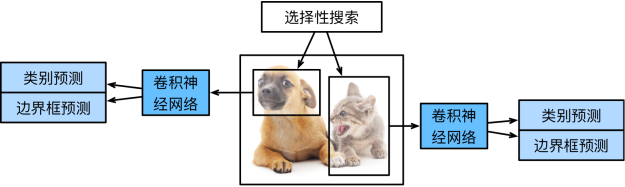
r-cnn

特点

  • 使用启发式搜索算法selective search来选择锚框
  • 使用预训练模型pretraining-mode对每个锚框抽取特征
  • 训练一个SVM来对类别分类
  • 训练一个线性回归模型来预测边缘框偏移

一个图片变为一千张小图片 ,计算量很大

RoI Pooling 兴趣区域池化层

  • 给定一个锚框,均匀分割为nxm块,输出每块里的最大值。
    • 每个锚框的大小不同,但是作为分类依据的时候需要变为相同的大小,作为batch
  • 不管锚框多大,总是输出nm个值

具体流程

  1. 对输入图像使用选择性搜索来选取多个高质量的提议区域(proposal region) (Uijlings et al., 2013)。这些提议区域通常是在多个尺度下选取的,并具有不同的形状和大小。每个提议区域都将被标注类别和真实边界框;
  2. 选择一个预训练的卷积神经网络,并将其在输出层之前截断。将每个提议区域变形为网络需要的输入尺寸(RoI Pooling),并通过前向传播输出抽取的提议区域特征;
  3. 将每个提议区域的特征连同其标注的类别作为一个样本。训练多个支持向量机对目标分类,其中每个支持向量机用来判断样本是否属于某一个类别;
  4. 将每个提议区域的特征连同其标注的边界框作为一个样本,训练线性回归模型来预测真实边界框。

Fast RCNN

特点

  • 使用CNN对图片进行特征抽取
  • 使用ROI池化层对每个锚框生成固定长度特征

SSD

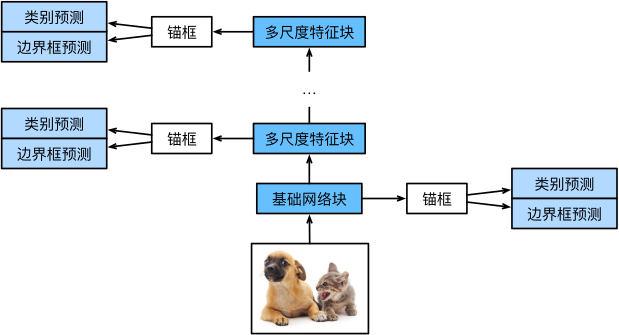
结构

ssd
基础网络块

​ 2 x 3 x 256 x 256 --> 2 x 64 x 32 x 32 作用:抽特征,获取feature map(Y) 2 x 64 x 32 x 32

锚框生成

​ multibox_prior(data,size,ratio) 作用:根据data的高、宽以及锚框的size ratio生成锚框 32 x 32 x (3+2-1)

类别预测

​ cls_predictor(Y) 作用:根据feature map预测每个像素的锚框可能的类别 32 x 32 x (3+2-1) x (1+1)

边界预测

​ box_predictor(Y) 作用:根据feature map 预测每个锚框的位置 32 x 32 x (3+2-1) x 4

理解
  • 特征图 2 x 64 x 32 x 32

  • 用 cls_predictor Conv2d(64,8,kernel=3,padding=1) 从特征图中抽出8类作为新的特征

    • 输出通道为8,8个滤波器
    • 每个滤波器 卷积核 3 x 3 x 64
    • 专门抽类别特征的,卷积核里的参数慢慢训练为可以做类别分类的
  • 用 box_predictor Conv2d(64,16,kernel=3,padding=1) 从特征图中抽出16个偏置(4x4)作为新的特征

    • 输出通道为16,16个滤波器
    • 每个滤波器 卷积核 3 x 3 x 64
    • 专门抽偏置特征的,卷积核里的参数慢慢训练为可以获取偏置的
  • 无论输入图像的通道是多少,每经过一个滤波器都将生成一个通道为1的特征图。

  • 一个卷积层之内可定义多个滤波器,当前卷积层上的各个滤波器会对上一层输入的每个feature map(特征图)分别执行卷积操作,即每个滤波器都会对应生成一个新的特征图feature map(不同的滤波器所提取的特征不同)。

  • 故而在下一层需要多少个特征图,本层就需要定义多少个滤波器,即滤波器的个数与传出的特征图的张数一致。

代码

1
2
3
4
5
6
7
8
9
10
11
12
13
%matplotlib inline
import torch
import torchvision
from torch import nn
from torch.nn import functional as F
from d2l import torch as d2l

# num_anchors 每个像素的对应生成的锚框个数
# num_classes 预测的类别数
# num_anchors *(num_classes+1) 所有锚框所有预测的类别
def cls_predictor(num_inputs, num_anchors, num_classes):
return nn.Conv2d(num_inputs, num_anchors * (num_classes + 1),
kernel_size=3, padding=1)
1
2
3
4
# 预测和正确的bbx的偏移
def bbox_predictor(num_inputs, num_anchors):
return nn.Conv2d(num_inputs, num_anchors * 4,
kernel_size=3, padding=1)
1
2
3
4
5
6
7
8
# 通道数挪到最后,然后flatten
# start_dim = 1 把后面三个维度拉成一个向量
def flatten_pred(pred):
return torch.flatten(pred.permute(0, 2, 3, 1), start_dim=1)

# 拉成向量之后在第一个维度拼接
def concat_preds(preds):
return torch.cat([flatten_pred(p) for p in preds], dim=1)
1
2
3
4
5
6
7
8
9
10
11
12
13
# 改变输出通道的数量 高宽减半块
def down_sample_blk(in_channels, out_channels):
blk = []
for _ in range(2):
blk.append(nn.Conv2d(in_channels, out_channels,
# 不改变高宽
kernel_size=3, padding=1))
blk.append(nn.BatchNorm2d(out_channels))
blk.append(nn.ReLU())
in_channels = out_channels
# 用最大池化层把高宽减半
blk.append(nn.MaxPool2d(2))
return nn.Sequential(*blk)
1
2
3
4
5
6
7
8
9
10
11
# 基本网络块
def base_net():
blk = []
num_filters = [3, 16, 32, 64]
for i in range(len(num_filters) - 1):
blk.append(down_sample_blk(num_filters[i], num_filters[i+1]))
return nn.Sequential(*blk)

# 3 -> 16 -> 32 -> 64
# 256 / 2^3 = 32
forward(torch.zeros((2, 3, 256, 256)), base_net()).shape
1
2
3
4
5
6
7
8
9
10
11
12
# 整体模型
def get_blk(i):
if i == 0:
blk = base_net()
elif i == 1:
blk = down_sample_blk(64, 128)
elif i == 4:
# 最后,把feature map变为 1x1
blk = nn.AdaptiveMaxPool2d((1,1))
else:
blk = down_sample_blk(128, 128)
return blk
1
2
3
4
5
6
7
8
9
10
11
12
13
# 定义前向计算 包含锚框处理的前向计算
def blk_forward(X, blk, size, ratio, cls_predictor, bbox_predictor):
# 计算当前stage的 feature map
Y = blk(X)
# 计算锚框
anchors = d2l.multibox_prior(Y, sizes=size, ratios=ratio)
cls_preds = cls_predictor(Y)
bbox_preds = bbox_predictor(Y)
# 返回当前stage卷积层的输出 feature map
# 卷积层输出上面的锚框
# 对每一个锚框类别的预测
# 每一个锚框对真实的锚框的偏移值的预测
return (Y, anchors, cls_preds, bbox_preds)
1
2
3
4
5
6
7
8
# 定义超参数
sizes = [[0.2, 0.272], # stage 1
[0.37, 0.447],
[0.54, 0.619],
[0.71, 0.79],
[0.88, 0.961]]# stage 5 锚框覆盖96%
ratios = [[1, 2, 0.5]] * 5
num_anchors = len(sizes[0]) + len(ratios[0]) - 1
1
2
3
4
5
6
7
8
9
10
11
12
13
14
15
16
17
18
19
20
21
22
23
24
25
26
27
28
29
30
31
# 定义完整网络
class TinySSD(nn.Module):
def __init__(self, num_classes, **kwargs):
super(TinySSD, self).__init__(**kwargs)
self.num_classes = num_classes
idx_to_in_channels = [64, 128, 128, 128, 128]
for i in range(5):
# 定义每个 stage blk、cls、bbx_predictor
# 即赋值语句self.blk_i=get_blk(i)
setattr(self, f'blk_{i}', get_blk(i))
setattr(self, f'cls_{i}', cls_predictor(idx_to_in_channels[i],
num_anchors, num_classes))
setattr(self, f'bbox_{i}', bbox_predictor(idx_to_in_channels[i],
num_anchors))
# 完整的forward函数
def forward(self, X):
anchors, cls_preds, bbox_preds = [None] * 5, [None] * 5, [None] * 5
# 5 个 stage
for i in range(5):
# 拿到每一步blk_forward()的值
# getattr(self,'blk_%d'%i)即访问self.blk_i
X, anchors[i], cls_preds[i], bbox_preds[i] = blk_forward(
X, getattr(self, f'blk_{i}'), sizes[i], ratios[i],
getattr(self, f'cls_{i}'), getattr(self, f'bbox_{i}'))
anchors = torch.cat(anchors, dim=1)
cls_preds = concat_preds(cls_preds)
cls_preds = cls_preds.reshape(
cls_preds.shape[0], -1, self.num_classes + 1)
bbox_preds = concat_preds(bbox_preds)
# 返回每一个层的Anchors 类别的预测和bbox的预测
return anchors, cls_preds, bbox_preds
1
2
3
4
5
6
7
8
9
10
11
12
13
14
net = TinySSD(num_classes=1)
X = torch.zeros((32, 3, 256, 256))
anchors, cls_preds, bbox_preds = net(X)

print('output anchors:', anchors.shape)
print('output class preds:', cls_preds.shape)
print('output bbox preds:', bbox_preds.shape)

# 一共有 5444 个锚框 每个锚框由4个值确定
#output anchors: torch.Size([1, 5444, 4])
# 32个 批次 5444 个锚框 每个锚框 2 个类别
#output class preds: torch.Size([32, 5444, 2])
# 32个 批次 5444 个锚框 每个锚框的4个确定位置的值离真实bbx的偏移
#output bbox preds: torch.Size([32, 21776])
1
2
3
4
5
6
# 训练
batch_size = 32
train_iter, _ = d2l.load_data_bananas(batch_size)

device, net = d2l.try_gpu(), TinySSD(num_classes=1)
trainer = torch.optim.SGD(net.parameters(), lr=0.2, weight_decay=5e-4)
1
2
3
4
5
6
7
8
9
10
11
12
13
14
15
16
17
# 定义损失函数
# 其中包含了类的预测和损失函数的预测

cls_loss = nn.CrossEntropyLoss(reduction='none')
# 做减法取绝对值 防止距离过大导致损失过大
# 弃疗了,预测很差的锚框不需要,所以不需要这种损失算出来很大的锚框
# 也不需要算很大的损失
bbox_loss = nn.L1Loss(reduction='none')

def calc_loss(cls_preds, cls_labels, bbox_preds, bbox_labels, bbox_masks):
batch_size, num_classes = cls_preds.shape[0], cls_preds.shape[2]
cls = cls_loss(cls_preds.reshape(-1, num_classes),
cls_labels.reshape(-1)).reshape(batch_size, -1).mean(dim=1)
# mask 当锚框为背景框的时候就不用预测偏倚
bbox = bbox_loss(bbox_preds * bbox_masks,
bbox_labels * bbox_masks).mean(dim=1)
return cls + bbox
1
2
3
4
5
6
7
def cls_eval(cls_preds, cls_labels):
# 由于类别预测结果放在最后一维,argmax需要指定最后一维。
return float((cls_preds.argmax(dim=-1).type(
cls_labels.dtype) == cls_labels).sum())

def bbox_eval(bbox_preds, bbox_labels, bbox_masks):
return float((torch.abs((bbox_labels - bbox_preds) * bbox_masks)).sum())
1
2
3
4
5
6
7
8
9
10
11
12
13
14
15
16
17
18
19
20
21
22
23
24
25
26
27
28
29
30
31
32
33
# 模型训练
num_epochs, timer = 20, d2l.Timer()
animator = d2l.Animator(xlabel='epoch', xlim=[1, num_epochs],
legend=['class error', 'bbox mae'])
net = net.to(device)
for epoch in range(num_epochs):
# 训练精确度的和,训练精确度的和中的示例数
# 绝对误差的和,绝对误差的和中的示例数
metric = d2l.Accumulator(4)
net.train()
for features, target in train_iter:
timer.start()
trainer.zero_grad()
# Y 真实的物体的bbx
# 不能直接预测Y 要预测锚对应的类别和与真实bbx之间的偏移量
X, Y = features.to(device), target.to(device)
# 生成多尺度的锚框,为每个锚框预测类别和偏移量
anchors, cls_preds, bbox_preds = net(X)
# 为每个锚框标注类别和偏移量
bbox_labels, bbox_masks, cls_labels = d2l.multibox_target(anchors, Y)
# 根据类别和偏移量的预测和标注值计算损失函数
l = calc_loss(cls_preds, cls_labels, bbox_preds, bbox_labels,
bbox_masks)
l.mean().backward()
trainer.step()
metric.add(cls_eval(cls_preds, cls_labels), cls_labels.numel(),
bbox_eval(bbox_preds, bbox_labels, bbox_masks),
bbox_labels.numel())
cls_err, bbox_mae = 1 - metric[0] / metric[1], metric[2] / metric[3]
animator.add(epoch + 1, (cls_err, bbox_mae))
print(f'class err {cls_err:.2e}, bbox mae {bbox_mae:.2e}')
print(f'{len(train_iter.dataset) / timer.stop():.1f} examples/sec on '
f'{str(device)}')
1
2
3
4
5
6
7
8
9
10
11
12
13
X = torchvision.io.read_image('../data/banana.jpg').unsqueeze(0).float()
img = X.squeeze(0).permute(1, 2, 0).long()
# 预测
def predict(X):
net.eval() # 预测模式
anchors, cls_preds, bbox_preds = net(X.to(device))
cls_probs = F.softmax(cls_preds, dim=2).permute(0, 2, 1)
output = d2l.multibox_detection(cls_probs, bbox_preds, anchors)
idx = [i for i, row in enumerate(output[0]) if row[0] != -1]
# 只保留NMS留下的idx
return output[0, idx]

output = predict(X)
1
2
3
4
5
6
7
8
9
10
11
12
def display(img, output, threshold):
d2l.set_figsize((5, 5))
fig = d2l.plt.imshow(img)
for row in output:
score = float(row[1])
if score < threshold:
continue
h, w = img.shape[0:2]
bbox = [row[2:6] * torch.tensor((w, h, w, h), device=row.device)]
d2l.show_bboxes(fig.axes, bbox, '%.2f' % score, 'w')

display(img, output.cpu(), threshold=0.9)

语义分割

转置卷积

特点
  • 普通卷积算子不会增大输入的高、宽,通常要么不变,要么减半
  • 转置卷积可以用来增大输入的高宽
原因
  • 常用的卷积算子算到最后像素级别的数据被压缩到很小的范围
  • 但是语义分割需要输出像素级别精度的类别,所以需要数据扩充
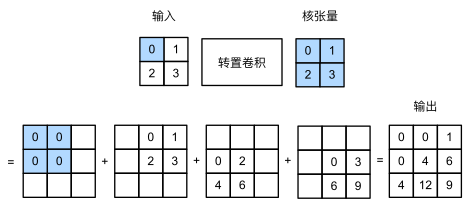
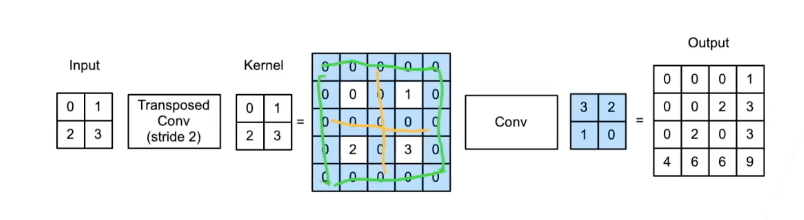
../_images/trans_conv.svg
概念
  • 转置卷积是一种计算方式
  • 卷积一般做下采样,转置卷积一般做上采样
  • 意义在于
    • 如果你使用某种卷积使得输入\((h,w)\)变为\((h',w')\)
    • 那么你可以使用同样超参数的转置卷积,使得输入\((h',w')\)变为\((h,w)\)
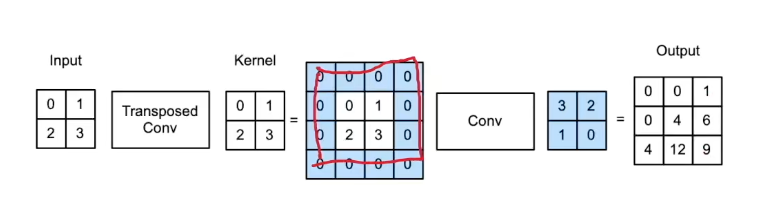
  • 填充为0 步幅为1
    • 计算方式1
      • 将输入填充k-1
      • 将核矩阵上下、左右翻转
      • 做正常卷积(填充0,步幅1)
    • 计算方式2
      • 按转置卷积的方式计算
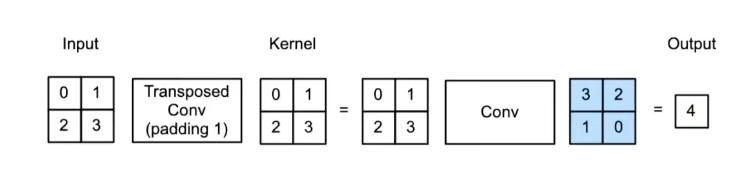
      transposed-conv1
  • 填充为p 步幅为1
    • 计算方式1
      • 将输入填充k-p-1
      • 将核矩阵上下、左右翻转
      • 然后做正常卷积(填充0,步幅1)
    • 计算方式2
      • 按转置卷积的方式计算
      • 在转置卷积的结果上去掉padding=1(外围一层)
      transposed-conv2
  • 填充为p 步幅为s
    • 计算方法1
      • 在行和列之间插入s-1行或列
      • 将输入填充k-p-1
      • 将核矩阵上下、左右翻转
      • 然后做正常卷积(填充0,步幅1)
    • 计算方法2
      • 按转置卷积的方式计算
      transposed-conv3
  • 形状换算
    • 输入高(宽)为n,核k,填充p,步幅s
    • 转置卷积:n'=sn+k-2p-s
      • 卷积:n'=[(n-k-2p+s)]/s
    • 如果让高、宽成倍增加
      • k=2p+s
总结
  • 转置卷积是一种变化了输入和核的卷积,用来达到上采样的目的
  • 不等同于数学上的反卷积操作 ##### 案例
1
2
3
4
5
6
7
8
9
10
11

# 手撸版本
def trans_conv(X,K):
h, w = K.shape
# 设置输出形状
Y = torch.zeros((X.shape[0]+h-1,X.shape[1]+w-1))
for i in range(X.shape[0]):
for j in range(X.shape[1]):
Y[i:i+h,j:j+w] += X[i,j]*K
return Y

1
2
3
4
5
6
7
8

# API版本
# 设置转置卷积形状
tconv = nn.ConvTranspose2d(1,1,kernel_size=2,bias=False)
# 设置转置卷积参数
tconv.weight = K
# 计算
tconv(X)
填充

与常规卷积不同,在转置卷积中,填充被应用于的输出(常规卷积将填充应用于输入)。 例如,当将高和宽两侧的填充数指定为1时,转置卷积的输出中将删除第一和最后的行与列。

1
2
3
4
5
6
7
8
9
10

# 填补Padding
# Padding = 1
# 原过程:在“输出”的基础上 上下填补计算普通卷积得到“输入”
# 转置卷积过程:输入计算转置卷积再去掉上下填补的部分
# padding=1 把不含padding转置卷积的结果除掉padding
tconv = nn.ConvTranspose2d(1,1,kernel_size=2,padding=1,bias=False)
tconv.weigth.data = K
tconv(X)

1
2
3
4
5
6
7
8

# 步长Stride

# 步长输出计算公式 和卷积相反
tconv = nn.ConvTranspose2d(1,1,kernel_size=2,bias=False)
tconv.weight.data = K
tconv(X)

1
2
3
4
5
6
7
# 与通道的关系
X = torch.rand(size=(1, 10, 16, 16))
conv = nn.Conv2d(10, 20, kernel_size=5, padding=2, stride=3)
tconv = nn.ConvTranspose2d(20, 10, kernel_size=5, padding=2, stride=3)
tconv(conv(X)).shape == X.shape

# 若卷积的过程中不发生向下取整则成立

全卷积网络(FCN)

定义

全卷积网络将中间层特征图的高宽变换回输入图像的尺寸。 最后的通道维输出该位置对应像素的类别预测。

构造

全卷积网络先使用卷积神经网络抽取图像特征,然后通过卷积层将通道数变换为类别个数,最后在通过转置卷积层将特征图的高和宽变换为输入图像的尺寸。 因此,模型输出与输入图像的高和宽相同,且最终输出通道包含了该空间位置像素的类别预测。

特点

双线性插值常用于初始化转置卷积层

代码
1
2
3
4
5
6
%matplotlib inline
import torch
import torchvision
from torch import nn
from torch.nn import functional as F
from d2l import torch as d2l
1
2
3
4
# 加载预训练模型,resnet18
pretrained_net = torchvision.models.resnet18(pretrained=True)
# resnet18 最后的全局平均池化层和全连接层不要
net = nn.Sequential(*list(pretrained_net.children())[:-2])
1
2
3
4
5
6
7
8
# 定义训练类别
num_classes = 21

# 网络最后两层改为
# in_channel 512 out_channel 21类别的1x1卷积层 把通道数从512降到21
# in_channel 21类别 out_channel 21类别 把h w 还原为 [320,480]
net.add_module('final_conv', nn.Conv2d(512, num_classes, kernel_size=1))
net.add_module('transpose_conv', nn.ConvTranspose2d(num_classes, num_classes,kernel_size=64, padding=16, stride=32))
1
2
3
4
5
6
7
8
9
10
11
12
13
14
15
16
17

# 定义双线性上采样方法,用该方法初始化转置卷积的初始参数
def bilinear_kernel(in_channels, out_channels, kernel_size):
factor = (kernel_size + 1) // 2
if kernel_size % 2 == 1:
center = factor - 1
else:
center = factor - 0.5
og = (torch.arange(kernel_size).reshape(-1, 1),
torch.arange(kernel_size).reshape(1, -1))
filt = (1 - torch.abs(og[0] - center) / factor) * \
(1 - torch.abs(og[1] - center) / factor)
weight = torch.zeros((in_channels, out_channels,
kernel_size, kernel_size))
weight[range(in_channels), range(out_channels), :, :] = filt
return weight

1
2
3
# 初始化转置卷积层参数并应用参数
W = bilinear_kernel(num_classes, num_classes, 64)
net.transpose_conv.weight.data.copy_(W);
1
2
3
4
5
6
7
8
9
10
# 具体训练过程
batch_size, crop_size = 32, (320, 480)
train_iter, test_iter = d2l.load_data_voc(batch_size, crop_size)

def loss(inputs, targets):
return F.cross_entropy(inputs, targets, reduction='none').mean(1).mean(1)

num_epochs, lr, wd, devices = 5, 0.001, 1e-3, d2l.try_all_gpus()
trainer = torch.optim.SGD(net.parameters(), lr=lr, weight_decay=wd)
d2l.train_ch13(net, train_iter, test_iter, loss, trainer, num_epochs, devices)
1
2
3
4
5
6
7
# 预测
def loss(inputs, targets):
return F.cross_entropy(inputs, targets, reduction='none').mean(1).mean(1)

num_epochs, lr, wd, devices = 5, 0.001, 1e-3, d2l.try_all_gpus()
trainer = torch.optim.SGD(net.parameters(), lr=lr, weight_decay=wd)
d2l.train_ch13(net, train_iter, test_iter, loss, trainer, num_epochs, devices)
1
2
3
4
5
6
7
8
9
10
11
12
13
14
15
16
17
# 像素标号
def label2image(pred):
colormap = torch.tensor(d2l.VOC_COLORMAP, device=devices[0])
X = pred.long()
return colormap[X, :]
# 测试
voc_dir = d2l.download_extract('voc2012', 'VOCdevkit/VOC2012')
test_images, test_labels = d2l.read_voc_images(voc_dir, False)
n, imgs = 4, []
for i in range(n):
crop_rect = (0, 0, 320, 480)
X = torchvision.transforms.functional.crop(test_images[i], *crop_rect)
pred = label2image(predict(X))
imgs += [X.permute(1,2,0), pred.cpu(),
torchvision.transforms.functional.crop(
test_labels[i], *crop_rect).permute(1,2,0)]
d2l.show_images(imgs[::3] + imgs[1::3] + imgs[2::3], 3, n, scale=2);

样式迁移学习

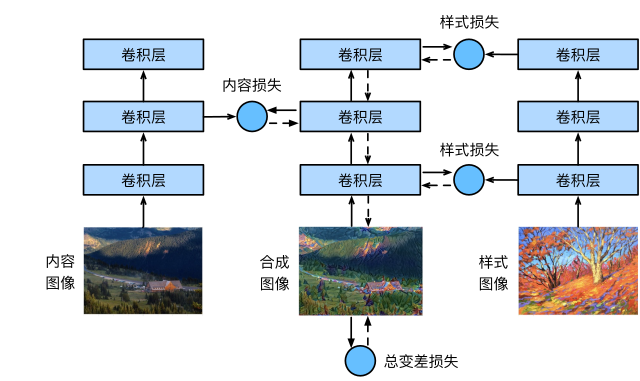
neural-style
思想
  • 一套网络复制三次,三个卷积层
  • 合成图像的像素值是最后的训练目标
  • 损失计算
    • 合成图像与样式图像计算样式损失
    • 合成图像与内容图像计算内容损失
    • 最后损失用权重汇总为总变差损失作为优化目标
代码
1
2
3
4
5
6
7
8
9
10
11
12
13
14
%matplotlib inline
import torch
import torchvision
from torch import nn
from d2l import torch as d2l

d2l.set_figsize()
# 加载图片
# 内容图片
content_img = d2l.Image.open('../data/banana-detection/bananas_train/images/753.png')
d2l.plt.imshow(content_img);
# 样式图片
style_img = d2l.Image.open('../img/autumn-oak.jpg')
d2l.plt.imshow(style_img);
1
2
3
4
5
6
7
8
9
10
11
12
13
14
15
16
17
18
19
20
rgb_mean = torch.tensor([0.485, 0.456, 0.406])
rgb_std = torch.tensor([0.229, 0.224, 0.225])
# 图像预处理
# preprocess 把图像转为Tensor
# Compose里存了 Resize,ToTensor和Normalize 有点像Sequential
# ToTensor 自动/255了
def preprocess(img, image_shape):
transforms = torchvision.transforms.Compose([
torchvision.transforms.Resize(image_shape),
torchvision.transforms.ToTensor(),
torchvision.transforms.Normalize(mean=rgb_mean, std=rgb_std)])
return transforms(img).unsqueeze(0)

# postprocess
# 把Tensor还原为图像
# [0,1] 大于1取1 小于0取0
def postprocess(img):
img = img[0].to(rgb_std.device)
img = torch.clamp(img.permute(1, 2, 0) * rgb_std + rgb_mean, 0, 1)
return torchvision.transforms.ToPILImage()(img.permute(2, 0, 1))
1
2
3
4
5
6
7
8
9
10
11
12
# 加载预训练网络
pretrained_net = torchvision.models.vgg19(pretrained=True)

# 从预训练网络中load我们所需要的层
# VGG19中 [0, 5, 10, 19, 28]层作为style_layers 抽取样式图像特征
# VGG19中 [25]层作为content_layers 抽取内容图像特征
style_layers, content_layers = [0, 5, 10, 19, 28], [25]

# 构建网络
net = nn.Sequential(*[pretrained_net.features[i] for i in
range(max(content_layers + style_layers) + 1)])

1
2
3
4
5
6
7
8
9
10
11
12
13
14
15
16
17
18
19
20
21
22
23
24
25
26
27
# 定义特征抽取函数
# 逐层计算 保留每层style与content抽取的特征
def extract_features(X, content_layers, style_layers):
contents = []
styles = []
for i in range(len(net)):
X = net[i](X)
if i in style_layers:
styles.append(X)
if i in content_layers:
contents.append(X)
return contents, styles

# 调用特征抽取函数,获取各层抽取的特征
def get_contents(image_shape, device):
# 预处理得到原始Content图像Tensor
content_X = preprocess(content_img, image_shape).to(device)
# 抽Contents特征
contents_Y, _ = extract_features(content_X, content_layers, style_layers)
return content_X, contents_Y

def get_styles(image_shape, device):
# 预处理得到原始Style图像Tensor
style_X = preprocess(style_img, image_shape).to(device)
# 抽Style图像特征
_, styles_Y = extract_features(style_X, content_layers, style_layers)
return style_X, styles
1
2
3
4
5
6
7
8
9
# 定义损失函数

#内容损失函数
def content_loss(Y_hat, Y):
# Y_hat content_Y 抽取的Contents特征Tensor
# Y: content_X 原始Content图像Tensor
# Y不需要计算梯度,Y.detach()可以写在外面
return torch.square(Y_hat - Y.detach()).mean()

1
2
3
4
5
6
7
8
9
10
# 定义损失函数

# 定格拉姆矩阵表达风格层输出的风格
def gram(X):
num_channels, n = X.shape[1], X.numel() // X.shape[1]
X = X.reshape((num_channels, n))
return torch.matmul(X, X.T) / (num_channels * n)
# 定义风格损失函数
def style_loss(Y_hat, gram_Y):
return torch.square(gram(Y_hat) - gram_Y.detach()).mean()
1
2
3
4
5
6
7
8
# 定义损失函数

# 定义TV损失函数(全变分,total variation denosing)
# 能够使得临近的像素值相似

def tv_loss(Y_hat):
return 0.5 * (torch.abs(Y_hat[:, :, 1:, :] - Y_hat[:, :, :-1, :]).mean() +
torch.abs(Y_hat[:, :, :, 1:] - Y_hat[:, :, :, :-1]).mean())
1
2
3
4
5
6
7
8
9
10
11
12
13
14
15
16
# 定义损失函数

# 综合三个损失函数计算方案

content_weight, style_weight, tv_weight = 1, 1e4, 10

def compute_loss(X, contents_Y_hat, styles_Y_hat, contents_Y, styles_Y_gram):
# 分别计算内容损失、风格损失和全变分损失
contents_l = [content_loss(Y_hat, Y) * content_weight for Y_hat, Y in zip(
contents_Y_hat, contents_Y)]
styles_l = [style_loss(Y_hat, Y) * style_weight for Y_hat, Y in zip(
styles_Y_hat, styles_Y_gram)]
tv_l = tv_loss(X) * tv_weight
# 对所有损失求和
l = sum(styles_l + contents_l + [tv_l])
return contents_l, styles_l, tv_l, l
1
2
3
4
5
6
7
8
9
10
11
# 初始化合成图像

# 合成的图像是训练期间唯一需要更新的变量,将合成图像视为模型的参数

class SynthesizedImage(nn.Module):
def __init__(self, img_shape, **kwargs):
super(SynthesizedImage, self).__init__(**kwargs)
self.weight = nn.Parameter(torch.rand(*img_shape))

def forward(self):
return self.weight
1
2
3
4
5
6
7
8
# 定义网络初始化函数 
# 提前计算风格层的格拉姆矩阵
def get_inits(X, device, lr, styles_Y):
gen_img = SynthesizedImage(X.shape).to(device)
gen_img.weight.data.copy_(X.data)
trainer = torch.optim.Adam(gen_img.parameters(), lr=lr)
styles_Y_gram = [gram(Y) for Y in styles_Y]
return gen_img(), styles_Y_gram, trainer
1
2
3
4
5
6
7
8
9
10
11
12
13
14
15
16
17
18
19
20
21
22
# 定义训练函数
def train(X, contents_Y, styles_Y, device, lr, num_epochs, lr_decay_epoch):
X, styles_Y_gram, trainer = get_inits(X, device, lr, styles_Y)
scheduler = torch.optim.lr_scheduler.StepLR(trainer, lr_decay_epoch, 0.8)
animator = d2l.Animator(xlabel='epoch', ylabel='loss',
xlim=[10, num_epochs],
legend=['content', 'style', 'TV'],
ncols=2, figsize=(7, 2.5))
for epoch in range(num_epochs):
trainer.zero_grad()
contents_Y_hat, styles_Y_hat = extract_features(
X, content_layers, style_layers)
contents_l, styles_l, tv_l, l = compute_loss(
X, contents_Y_hat, styles_Y_hat, contents_Y, styles_Y_gram)
l.backward()
trainer.step()
scheduler.step()
if (epoch + 1) % 10 == 0:
animator.axes[1].imshow(postprocess(X))
animator.add(epoch + 1, [float(sum(contents_l)),
float(sum(styles_l)), float(tv_l)])
return X
1
2
3
4
5
6
# 开始训练
device, image_shape = d2l.try_gpu(), (300, 450)
net = net.to(device)
content_X, contents_Y = get_contents(image_shape, device)
_, styles_Y = get_styles(image_shape, device)
output = train(content_X, contents_Y, styles_Y, device, 0.3, 500, 50)

深度学习 计算机视觉 笔记
https://anonymouslosty.ink/2023/06/18/深度学习 计算机视觉 笔记/
作者
Ling yi
发布于
2023年6月18日
更新于
2023年7月5日
许可协议